Bangladesh Projected to Overtake India in Per Capita GDP This Year, IMF Says
The IMF forecasts Bangladesh's per capita GDP will edge above India's in 2026, though India retains a far larger economy and stronger growth momentum.
By Worldwide Blast Staff ·
Bangladesh's per capita gross domestic product is projected to surpass that of India, Asia's third largest economy, this year, according to the International Monetary Fund's October 2026 World Economic Outlook report. The IMF estimates Bangladesh's per capita GDP at $2,886 for 2026, compared with $2,749 for India, the world's most populous nation.
The headline figures mask a vast difference in scale. India's total GDP is nearly eight times larger, at a projected $4.15 trillion against Bangladesh's $506.4bn. Per capita GDP simply divides economic output by population, and Bangladesh is home to about 175 million people. Its economy is now bigger than that of Pakistan, from which Dhaka seceded in 1971.
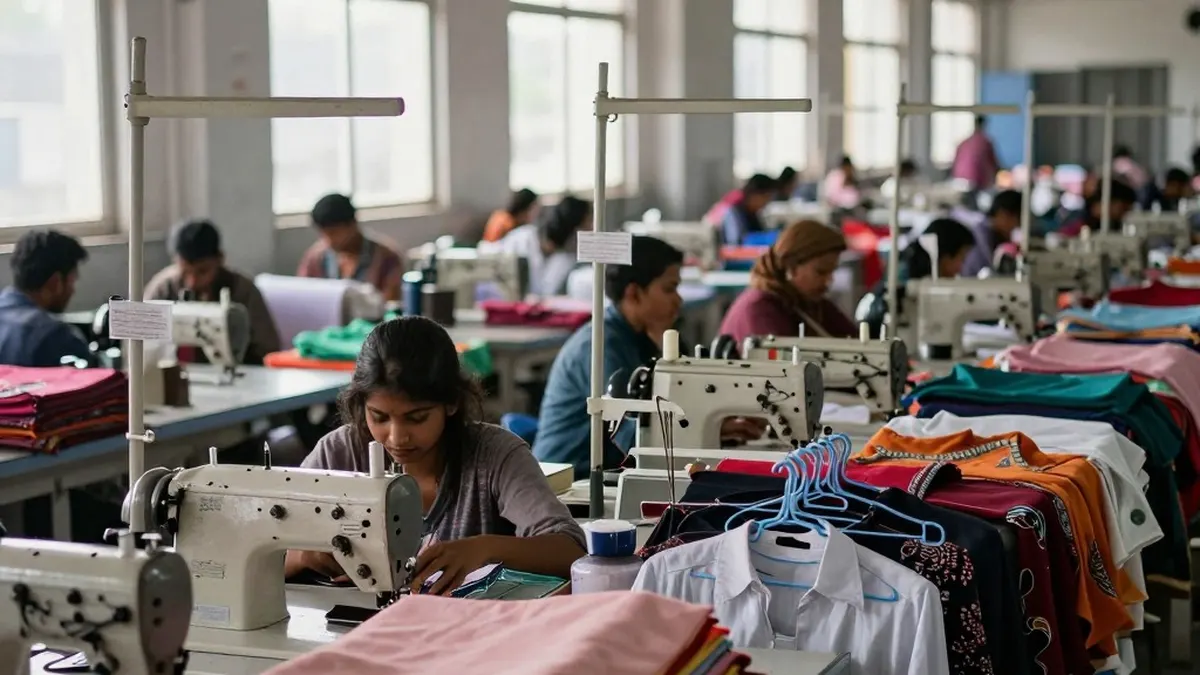
Analysts attribute Bangladesh's rise over the past two decades to its $38bn garment industry, remittances from workers abroad and the growing participation of women in the labour force. Santosh Mehrotra, an Indian economist, told Al Jazeera that Bangladesh has delivered consistent growth of 6 percent per annum alongside a long-term decline in population growth. He noted that manufacturing's contribution to gross value added climbed from 16.6 percent in 2014 to 22 percent in 2025, while World Bank data shows India's manufacturing value added slipping from 15.1 percent of GDP in 2014 to 13.5 percent in 2024.
"That's a positive side of export-oriented manufacturing growth that Bangladesh is getting right," Mehrotra said, though he and other analysts cautioned that growth in both countries has become increasingly concentrated among wealthier households.
The progress now faces serious headwinds. The IMF projects consumer-price inflation of 8.7 percent in Bangladesh this year, well above India's 5 percent, while Bangladesh's economy is expected to grow just 3.6 percent against India's 7 percent. The global energy shock from the United States-Israel war on Iran, which has disrupted maritime traffic through the Strait of Hormuz, has hit Bangladesh hard: the country imports 95 percent of its oil and liquefied natural gas, much of it from the Middle East. Its ready-made garment sector, which generates more than 80 percent of export earnings, has also suffered as shipment routes through the Red Sea and the Middle East have been disrupted.
The picture also reverses under purchasing power parity, a measure that adjusts for differences in local prices and the cost of living. On that basis, India's GDP per capita is projected at $12,998, comfortably ahead of Bangladesh's $10,884, meaning Indians have greater buying capacity. Economists also note that per capita GDP conceals inequalities in income and wealth, and that dollar-denominated figures can shift with exchange rates even when economic output is unchanged.
For broader context, both countries remain well below the average per capita GDP of about $7,746 for developing economies and the global average of roughly $15,889.
Looking ahead, the IMF expects Bangladesh's per capita GDP to reach $3,219 next year, still above India's projected $3,036, with a marginal gap persisting into 2028. By 2029, however, India's per capita GDP of $3,661 is forecast to overtake Bangladesh's $3,334, as India's more diversified economy, spanning services, manufacturing, agriculture, technology and consumer demand, continues to expand at nearly twice Bangladesh's pace.
Source: Al Jazeera